
Home & decor
Textured ocean wall art: how it's made, resin vs acrylic, and care
9 min read
Key takeaways
Textured ocean wall art is a seascape whose waves, foam and sand are raised off the canvas with texture paste and paint, often with real shells, so you can feel them. Resin versions are glossy and glass-like instead. Either way, keep it out of direct sun and damp rooms, and dust it with a soft, dry brush.
On this page9
- What is textured ocean wall art?
- How is a textured ocean painting made?
- Textured acrylic or resin: which is better for ocean art?
- How do you choose a textured ocean painting?
- Where should you hang textured ocean wall art?
- How do you clean and care for textured wall art with shells?
- Is textured ocean art a good gift?
- Ocean Melody: a round textured seascape by Karunika
- How does buying art on JADUZ work?
What is textured ocean wall art?
Textured ocean wall art is a seascape you can touch: the waves, foam and sand are built up off the surface with texture paste and thick paint, so they catch the light and cast small shadows. Many pieces add real sand, shells or beads, which is why the same kind of work is also sold as 3D ocean art, seashell wall art or mixed-media beach art.
Most pieces you will come across fall into two families. Textured acrylic is painted with acrylics over raised paste, usually on canvas, and the surface stays ridged and tactile. Resin art is poured in coats of tinted and clear epoxy resin, which sets into a glossy, glass-like skin. Some artists combine the two.
How is a textured ocean painting made?
A textured ocean painting is usually built in layers: the raised texture first, then the paint, then the details. The texture comes from a paste that the artist spreads and shapes, often with a palette knife, before it dries hard.
Golden Artist Colors, which makes acrylic paints and texture pastes for artists, describes its molding pastes as water-based products made with acrylic polymer emulsions that can be used to create textural surfaces; its regular Molding Paste contains marble dust. Golden notes that the paste can be shaped while wet or sanded and carved once dry, and that the dried paste accepts further layers of acrylic paint and mediums. That is what makes ocean texture possible: the artist sculpts the foam lines first, then paints the water around and over them.
Thick texture takes patience. Golden notes that drying time depends greatly on how thick the paste is. For its Hard Molding Paste, it advises against any single layer thicker than a quarter of an inch, to reduce the chance of cracking, and suggests building thicker effects in several layers.
Once the paint is dry, mixed-media pieces get their final touches: sand, shells, beads or a line of white on each wave crest. In handmade work each of these is placed by hand, which is one reason no two textured seascapes come out the same.
Textured acrylic or resin: which is better for ocean art?
Neither is better; they look and behave differently. Textured acrylic gives a ridged surface you can feel and a softer, less glassy finish, while resin gives deep colour under a glossy, glass-like coat.
ArtResin, which makes epoxy resin for artists, explains that resin art gets its high gloss from layering several coats of clear or pigmented resin, and that objects such as shells can be embedded between the coats. It also notes that acrylic paint typically dries with a matte finish, and that epoxy resin is heavy, so it is best poured onto a wooden panel or canvas board, while an acrylic pour can be done on a stretched canvas.
Light treats them differently too. ArtResin says UV light, with sunlight the biggest culprit, is the most common cause of yellowing in cured resin, and that no resin maker can guarantee its product will never yellow. Painted acrylic needs shade as well: the American Institute for Conservation (AIC) warns that direct sunlight can fade certain pigments, yellow varnish and overheat the paint surface.
A quick comparison:
- Surface: textured acrylic is ridged and you can feel it; resin is usually smooth and glassy.
- Finish: textured acrylic is less glassy; resin is high gloss.
- Base: because resin is heavy, ArtResin recommends a wooden panel or canvas board; textured acrylic is often on stretched canvas.
- Shells: on textured acrylic they sit on the surface, where you can touch them; in resin they can be sealed between coats.
How can you tell which one you are looking at?
Look at how light reflects off the surface. Resin usually throws back a sharp, mirror-like reflection, while textured acrylic breaks the light into small highlights along each ridge. If the listing doesn't say, ask the maker what the surface is made of before you buy.
How do you choose a textured ocean painting?
Start with the wall, not the painting: measure the space, then check the piece's size on its product page, or ask the maker, before you buy.
- Size: measure the wall, then hold up a sheet of paper or a plate the same size as the piece to see how it sits.
- Angled photos: look for photos taken from the side, which show how high the foam lines stand and how the shells are fixed.
- Materials: ask whether the shells are natural and whether any pearls are real or decorative beads. Either is fine; you just want to know what you are paying for.
- Original or print: ask whether the whole piece was painted by hand or whether texture was added on top of a printed image.
- Shape: a round canvas works as a single focal point on a narrow wall or above a side table, a console or a bed; a long rectangle suits a wider wall above a sofa.
- The maker: a handmade seascape is a one-off, and knowing who made it, and where, is part of what you are buying.
Where should you hang textured ocean wall art?
Hang it on a dry inside wall that never gets direct sun, away from bathrooms, kitchens and air-conditioner vents. Light, heat and damp are what conservation guides warn about most.
The AIC's guide to caring for paintings warns that direct sunlight can fade certain pigments and overheat the paint surface. It advises against hanging paintings above heating and air-conditioning vents or in bathrooms with tubs or showers, because rapid swings in the environment do harm, and suggests a place away from high-traffic areas and moveable seating. The Canadian Conservation Institute (CCI) adds that humidity above 70–75% encourages mould, and that highly sensitive paints can show UV damage from unfiltered daylight within several months.
In a Bangladeshi home, especially through the monsoon, that comes down to a few rules:
- Pick a dry, airy room such as a living room or bedroom, not a bathroom or kitchen, where steam and damp collect.
- Keep it out of the path of sunlight from a window, even for part of the day.
- Don't hang it right under or beside an air conditioner. CCI also advises against displaying paintings near air vents or on a building's outside walls, to avoid sudden extremes of temperature and humidity.
- Use a proper picture hook, not a plain nail. The AIC recommends picture hooks fixed securely in the wall, and two hooks for a heavy picture.
For lighting, the AIC suggests indirect sunlight, recessed lighting or ceiling-mounted spotlights rather than lamps clipped to the top of the frame. Light falling at a slight angle also shows texture at its best, because it throws a small shadow beside every ridge.
How do you clean and care for textured wall art with shells?
Dust it with a soft, dry brush every few months, and never use water, wet cloths, sprays or cleaners. Hold it by the edge of the canvas, never by the shells or the raised texture.
The AIC suggests dusting paintings every four to six months, after checking for loose or flaking paint, with a soft bristle brush such as a sable makeup brush. It warns that feather dusters can scratch or snag on paintings, so around raised shells a soft brush is the safer choice. The AIC also says never to use any liquid or commercial cleaner on a painted surface, to avoid touching the paint with your fingers, and to keep air fresheners and furniture sprays away from artworks.
Acrylic has a particular reason to stay dry. In a 2006 study of cleaning acrylic paintings published by Tate, the researchers listed water and solvent sensitivity, the softness of acrylic paint and its tendency to take up dirt among conservators' concerns. A damp cloth can also catch on a shell and pull it loose.
For moving and storing:
- Lifting: use both hands, one on each side, as the AIC advises, with your fingers on the canvas edge rather than the shells.
- Storing: wrap it in soft paper or cloth and lay it flat, painted side up, with nothing on top. The AIC advises keeping stored paintings out of basements, garages and attics.
- Checking: if you notice flaking paint, cracks with lifting edges or mould, the AIC advises consulting a conservator rather than trying a fix yourself.
Is textured ocean art a good gift?
It is, for someone who loves the sea or is setting up a new home, as long as you check the size and pass on the care instructions. A handmade piece also carries its maker's name, which makes it more personal than a print.
It suits a housewarming, a wedding or a thank-you. Tuck the care guide in with it, and wrap it so that nothing presses on the texture. For more ideas, see our guides to handmade gift ideas from Bangladesh and wedding gifts couples keep.
Ocean Melody: a round textured seascape by Karunika
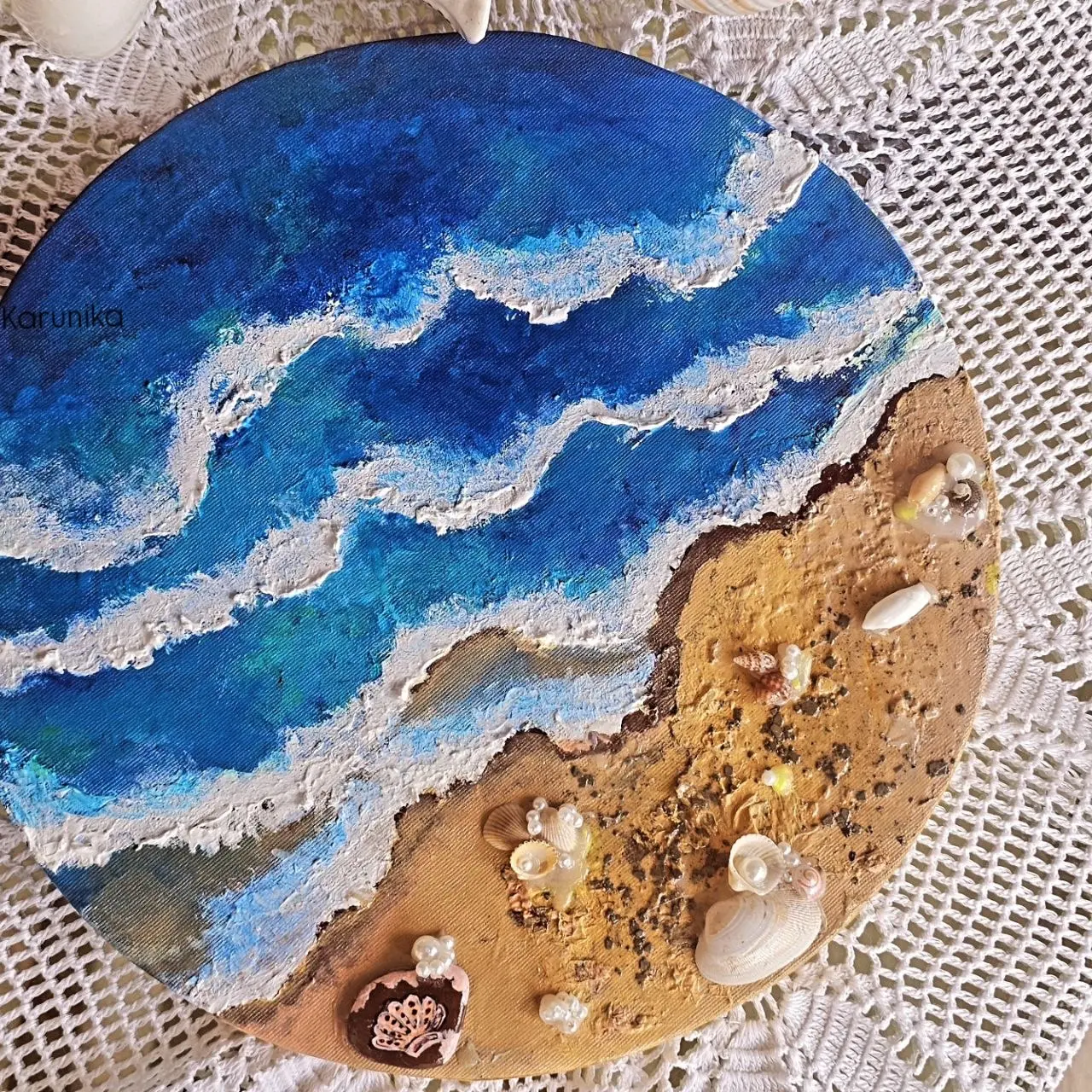
Ocean Melody is a one-of-a-kind textured, mixed-media painting by Karunika, an artist in Dhaka, made with acrylic paint, texture paste and natural seashells on a round canvas. There is only one.
 One of a kind
Karunika describes it as a piece that "captures the gentle motion of ocean waves breaking over a sandy shore". The view is from above, as if you were looking straight down at a beach: deep blue and turquoise water, three or four wave crests drawn in raised white texture for the foam, and golden sand with dark speckles. Small natural shells, cowrie-type and little spiral shells, sit on the sand beside pearl-bead details. The pearls are decorative beads, not real pearls, and the piece is textured acrylic, not resin. It is signed "Karunika".
The care advice above applies in full. If it has to fit a particular spot, confirm the size before you buy; the product page has the photos and details. See more of her work on Karunika's maker page, or read Karunika's story.
How does buying art on JADUZ work?
On JADUZ you pay cash on delivery, and you open the parcel in front of the rider before you pay. If it is damaged or wrong, hand it back and pay nothing. Once the rider has left, it can't be returned.
A curator reviews each maker before they can sell and approves every piece before it goes live, and every piece shows the maker's name and district. The returns page explains the doorstep check, and how JADUZ works covers the rest. Browse more wall art, or meet the makers.