
Home & decor
Islamic calligraphy wall art in Bangladesh: price, placement, scripts
9 min read
Key takeaways
Islamic calligraphy wall art in Bangladesh costs from about ৳590 for a printed PVC set to ৳2,000–৳10,000 for a hand-painted canvas, depending on size and lettering. Buy hand-painted if the text matters, have the Arabic checked, and hang it high in a clean living space, never in a bathroom. For rulings on your own home, ask a scholar you trust.
On this page10
- What is Islamic calligraphy wall art, and what does it cost?
- Is Islamic calligraphy wall art allowed in Islam?
- Where should you hang it, and where not?
- Which verse or phrase should you choose?
- Which calligraphy script should you choose?
- What size should you buy?
- How much does hand-painted calligraphy cost?
- Hand-painted or printed: how can you tell?
- Where can you buy Islamic calligraphy in Bangladesh?
- How do you hang and care for it?
What is Islamic calligraphy wall art, and what does it cost?
It's Arabic lettering made into a piece for the wall: usually a verse of the Quran, a name of God or a short prayer, written in one of the classical scripts. In Bangladesh it runs from printed PVC sets at about ৳590 to hand-painted canvases at ৳2,000 to ৳10,000, and a painted wall starts near ৳1 lakh. Our advice: if the words matter to you, buy hand-painted from someone who checks the text, and hang it where you'll actually read it.
Islamic calligraphy prices at a glance
| What you buy | Typical price | An example we found |
|---|---|---|
| Printed PVC board set | ৳550–৳1,100 | Nine-piece PVC wallboard set: ৳590 (2026) |
| Printed canvas | ৳800–৳5,000 | Small print ৳800–৳1,500, large ৳2,000–৳5,000 (2026) |
| Hand-painted canvas | ৳2,000–৳10,000 | By size and lettering, Dhaka (2024) |
| Hand-painted wall mural | ৳1 lakh and up | A Dhaka muralist's minimum budget (2026) |
Calligraphy in Bangladesh has grown fast. In two decades the number of people practising it informally has passed a thousand, by Prothom Alo's count, and the Art of Faith exhibition at the National Museum in September 2026 showed 310 works by 201 artists, in Arabic and Bangla, on paper, canvas, jute, wood, resin and steel.
Is Islamic calligraphy wall art allowed in Islam?
The fatwa bodies we read permit framed verses at home when they're honoured and protected, though some classical scholars disliked the practice. JADUZ doesn't give religious rulings, so for your own home, ask a scholar you trust. Here is what the answers say.
- It's writing, not a picture. The often-cited objection to depicting people and animals applies to religious art, and calligraphy is writing, not an image of a living being.
- Verses in frames are permitted, with care. The Iftaa' Department of Jordan allows verses to be hung on walls in frames, but says they must be honoured and protected from offence, degradation or being thrown away. It records, from an older Hanafi text, that some scholars disliked the practice for fear the verses could fall and be stepped on.
- Intention matters. A 2022 answer from Darul Ifta Birmingham permits hanging verses to remind people of the Quran or to teach a verse such as Ayat al-Kursi, but not for decoration, for show or to display an expensive frame. Where verses hang, it asks for reverence: no smoking and no rude talk.
Where should you hang it, and where not?
Hang it high, in a clean room where you'll see it every day. Keep it out of the bathroom, and think twice about the bedroom.
Good places:
- The living or drawing room, as the main piece on its wall, at eye level or above.
- Near the entrance, where a short text such as Bismillah greets everyone who comes in.
- The dining area or a corridor, for a longer verse that people read up close.
- An office or shop, where visitors see it first.
Places to avoid:
- Bathrooms and toilets. Darul Uloom Deoband says it is not right to put Quranic verses or duas in a toilet, because it disrespects them.
- Low on a bedroom wall. Askimam's Mufti Muhammad Kadwa advises against verses in the bedroom, and says that if they hang low, level with the bed, you shouldn't sleep with your feet towards them; hung high, that isn't a concern. SeekersGuidance takes a lighter view: changing clothes in such a room isn't wrong, but where it's easy, dress elsewhere or cover the verses.
- The floor, a low shelf, or anywhere it can get dirty, wet or knocked down. That's the protection the Jordan answer asks for.
- Anywhere it can fall. Use two hooks, so a knock can't bring it down.
Which verse or phrase should you choose?
Choose a short text whose meaning you want to see every day, and put a translation beside the Arabic if family or guests don't read it.
- Bismillah (Al-Fatiha 1:1). "In the name of Allah, the Entirely Merciful, the Especially Merciful." Short enough for any size, and a natural choice by the door.
- Ayat al-Kursi, the Throne Verse (Al-Baqarah 2:255). One of the best-known verses, often memorised and displayed. It opens: "Allah, there is no deity except Him, the Ever-Living, the Self-Sustaining." It's long, so it needs a large canvas or a compact script.
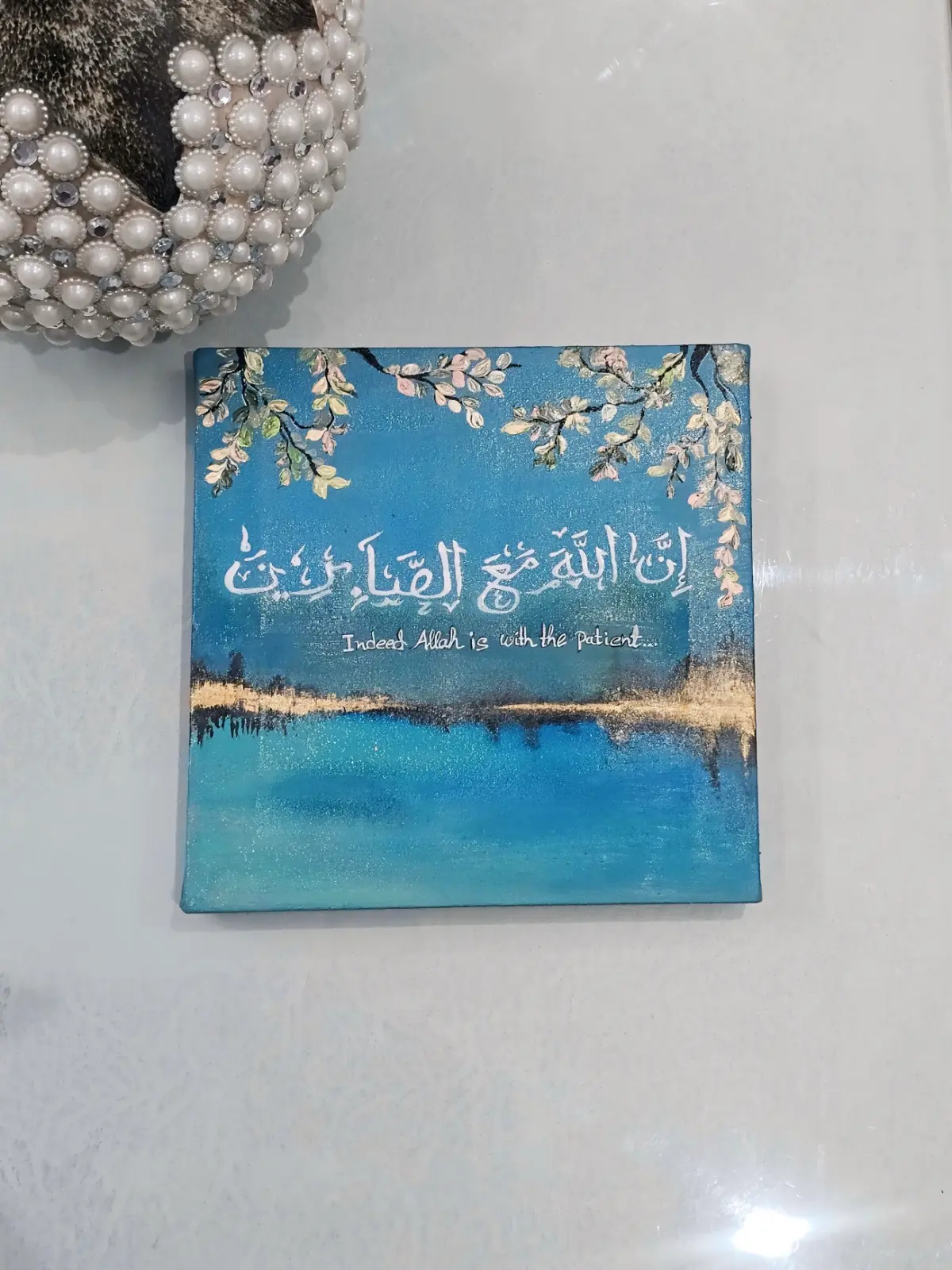
- Patience and prayer (Al-Baqarah 2:153). "O you who have believed, seek help through patience and prayer. Indeed, Allah is with the patient." It fits a small canvas.
- A name of God or the Prophet, a single word in a roundel.
Before a painter starts, ask them to check the Arabic, vowel marks included, against a printed Quran, and check it yourself when the piece arrives. A mistake in a verse isn't a small flaw.
Which calligraphy script should you choose?
Pick the script for how far away people will read it from. Calligraphers work in several classical scripts:
- Naskh. Thin lines and round letters make it the easiest to read; it became the usual script for copying the Quran and was adopted for printing. Choose it for a long verse.
- Thuluth. Tall and stately, used for titles and short inscriptions on buildings, metalwork and textiles. It suits one phrase on a large canvas and reads across a room.
- Kufic. Angular, with short verticals and long horizontals. From the second half of the 8th century it was the only script used to copy the Quran, for about three hundred years.
- Square Kufic. A geometric grid of straight lines that grew out of lettering on buildings. It looks modern, but it's hard to read, so add a translation.
- Nastaliq. Fluid and slanting to the right, developed in Iran in the 14th and 15th centuries.
- Diwani. Developed by Ottoman calligraphers as a hand for official documents.
If a seller can't name the script, ask for a close-up photo of the letters before you buy.
What size should you buy?
Measure the wall and the furniture first. Over a sofa, a piece looks right at no more than two-thirds of the sofa's width, hung 4 to 8 inches (10 to 20 cm) above its back. On a bare wall, put the centre about 57 inches (145 cm) from the floor.
- Small canvases suit a shelf, a desk, a narrow wall by the door, or a group of two or three.
- Medium pieces, around the width of an armchair, suit a single phrase in a living room.
- Large pieces are for a long verse like Ayat al-Kursi, or for one word that has to read across a big room.
Our drawing room decoration ideas cover the rest of the room.
How much does hand-painted calligraphy cost?
A hand-painted calligraphy canvas sold for ৳2,000 to ৳10,000 in Dhaka in 2024, depending on its size and lettering, according to the Dhaka Tribune. Classified ads for hand-painted canvases of all subjects asked between ৳550 and ৳5,000 on Bikroy in October 2026; treat those as asking prices.
What pushes the price up:
- Size. More canvas, more paint, more hours.
- The number of words. At the same size, a whole Ayat al-Kursi in fine Naskh takes far longer than one word in bold Thuluth.
- Gold leaf or foil, and layered or textured backgrounds.
- The artist. As with any painting, an established name costs more; see our painting price guide.
- Walls. Painting directly on a wall is harder than canvas and is priced like a mural: a Dhaka muralist put the minimum budget at ৳1 lakh in 2026.
Printed pieces sit far below. A nine-piece PVC set was ৳590 on BDstall in October 2026, and Rokomari listed a "handmade" Arabic calligraphy wall decor at ৳1,093 whose material line said PVC board.
Hand-painted or printed: how can you tell?
Look closely, tilt it under a lamp and read the material line.
- Zoom in with your phone. Tiny coloured dots in a regular grid mean a print.
- Follow the strokes. Hand-painted letters vary slightly in thickness and edge. A print's texture looks too even.
- Tilt it under a light. Hand-applied paint and gold sit thicker in places. Raised varnish that repeats in a pattern is a reproduction trick.
- Check the signature. It should be part of the paint, not printed flat.
- Read the listing. Look for the material, such as "acrylic on stretched canvas", not just the word "handmade".
Buying online? Ask for a close-up photo and a short video of the surface before you order.
Where can you buy Islamic calligraphy in Bangladesh?
- From calligraphers directly. Exhibitions such as Art of Faith are the best place to see many artists' work and meet them. For a commission, agree the text, script, size, colours, price and delivery date in writing, and ask to approve a sketch of the lettering before the painting starts.
- Online shops. Most calligraphy on marketplaces is printed PVC or canvas. Read the material line.
- JADUZ. Karunika, an artist in Dhaka, hand-paints small calligraphy canvases in acrylic with gold foil; her Islamic Calligraphy Canvas carries Al-Baqarah 2:153 in Arabic and English. For a bedroom, where some scholars advise against verses, her textured seascape is a calm alternative. Read her story, or browse wall art.
 Sold out
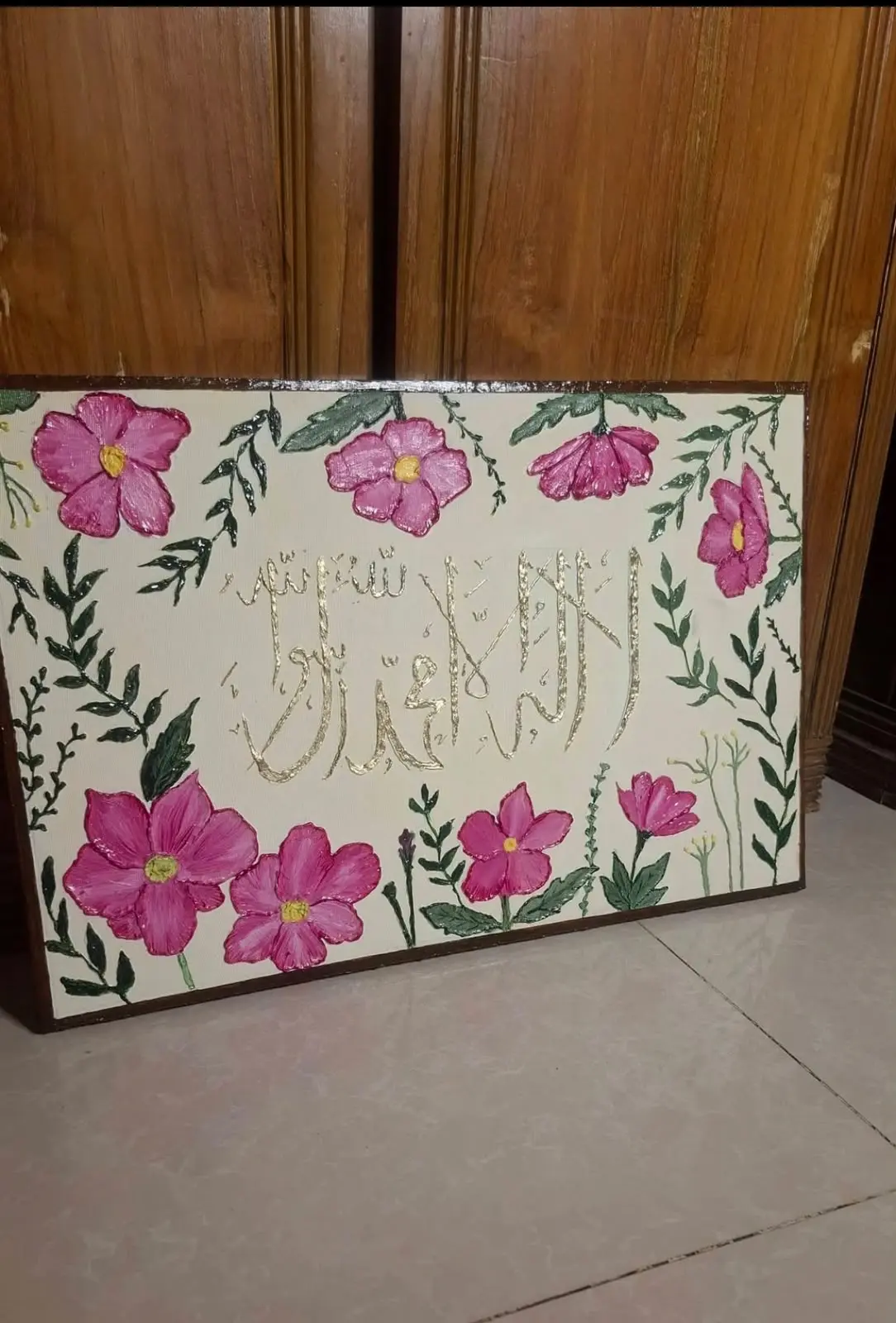
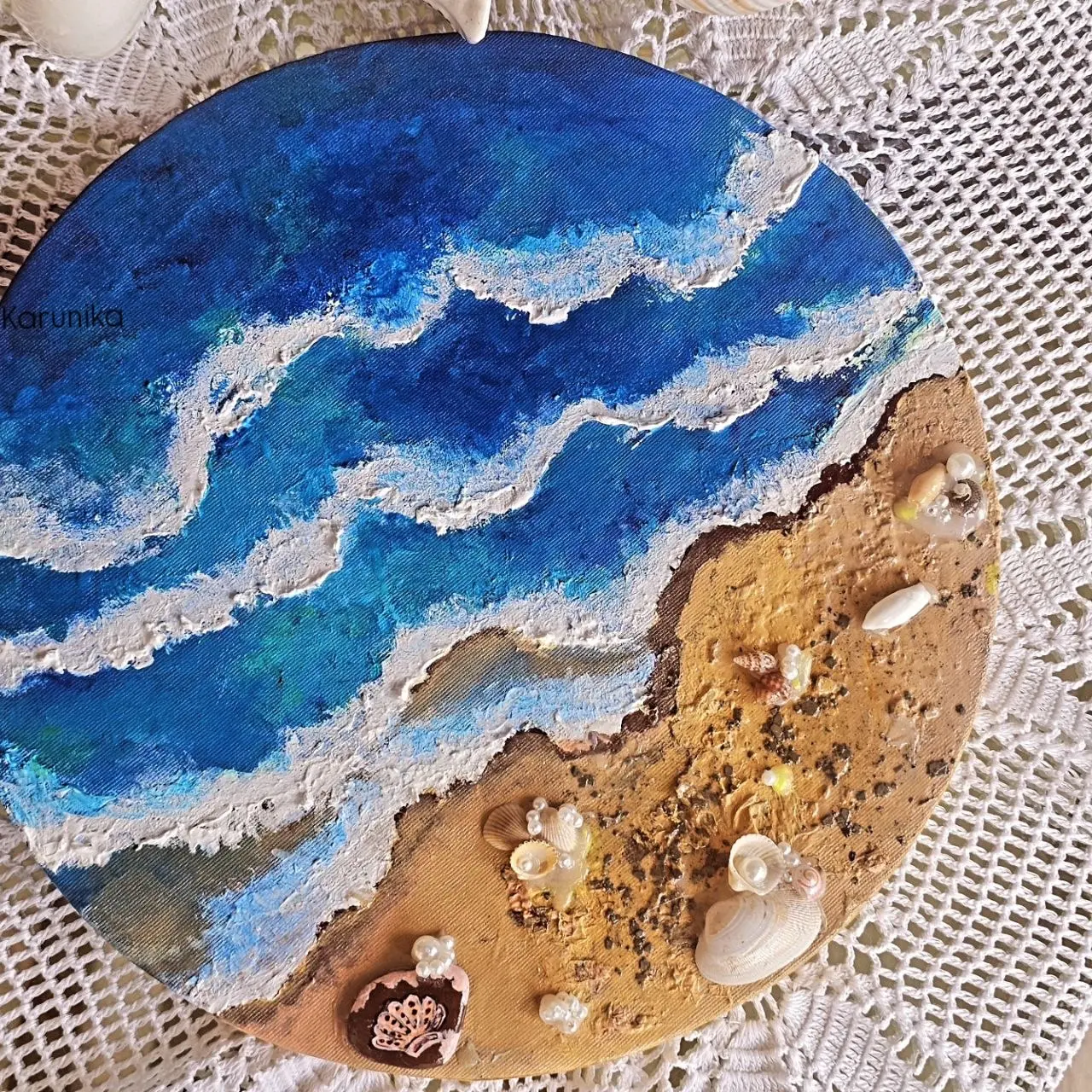 One of a kind
Calligraphy also makes a good gift for a new home or for Eid; our Eid gift guide has more ideas by budget. JADUZ orders are cash on delivery, and you check the piece at the door before you pay (how that works).
How do you hang and care for it?
Fix it firmly, keep it dry and out of the sun, and dust it gently.
- Two hooks or a proper wall anchor, rated for the weight, so it can't fall.
- Mind the damp. Paintings start to grow mould once humidity goes above 70–75%, and they suffer near air vents and on outer walls, where conditions swing, according to the Canadian Conservation Institute. In a monsoon flat, an inside wall away from the AC is safest.
- Keep it out of direct sun, which heats and dries the paint. Curtains or blinds cut the light.
- Dust, don't wash. Use a soft, dry brush, and keep water, wet wipes and sprays away, especially from gold detailing.